Almost half of all septic tanks inspected last year failed, posing risks to human health and the environment.
This is despite a more than doubling of the grant available to fix faulty systems.
It has led to calls from the Environmental Protection Agency (EPA) for increased enforcement, and prosecutions where warranted, to secure repairs and to protect the environment and public health.
The details are contained in the EPA’s Domestic Waste Water Treatment System Inspections 2023 report.
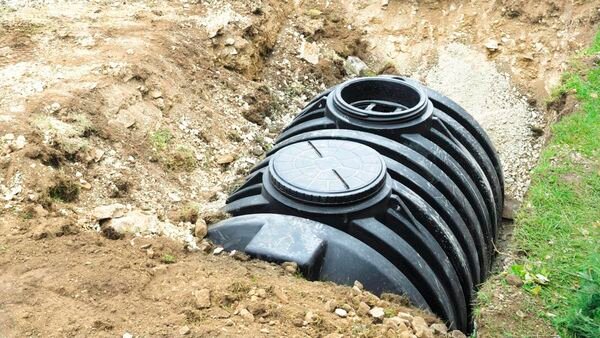
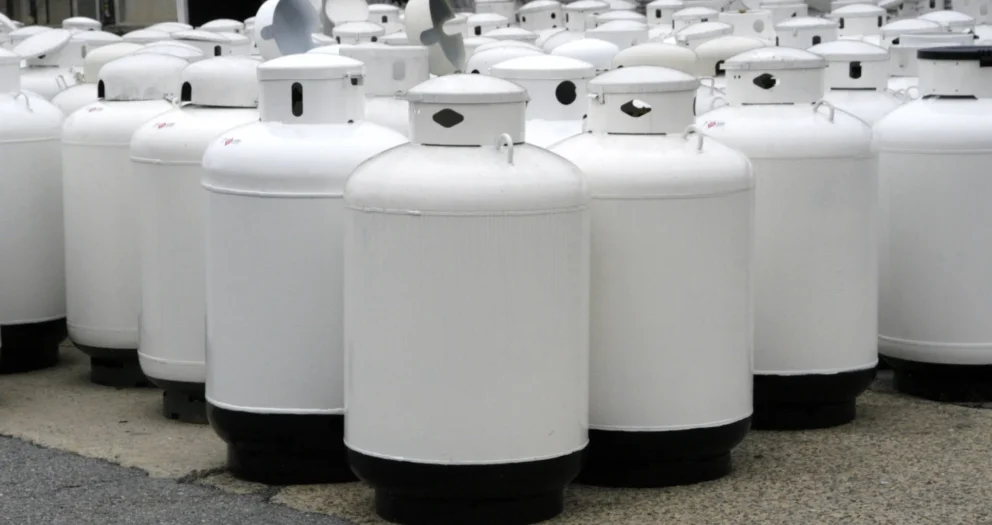
Domestic wastewater treatment systems, mostly septic tanks, are used by householders to treat sewage. There are nearly half a million such systems in Ireland.
The EPA’s national inspection plan requires local authorities to complete a minimum of 1,200 septic tank inspections annually, particularly those located near rivers and in areas where septic tanks are co-located with household drinking water wells, and which are most at risk of contamination by faulty septic tanks.
The inspections report shows that of the 1,189 systems inspected last year, 532 failed because they were not built or maintained properly.
Where an inspection is failed, local authorities issue advisory notices to householders setting out what is required to fix the problem.
Enforcement
However, the report shows that there were 576 cases where issues notified to the owners of septic tanks over two years previously had still not been addressed.
This is despite the septic tank remediation grant increasing from €5,000 to €12,000.
The report also shows that local authorities took just eight legal cases last year against householders for alleged failure to resolve faulty sewage treatment systems, with 95% of all legal actions taken by just four local authorities — Wexford, Kerry, Mayo, and Limerick.
The report says the enforcement of advisory notices by local authorities is inconsistent, with significant numbers of failures combined with a low level of resolution found in Waterford, Roscommon, and Kilkenny.
Dr Tom Ryan, the director of the EPA’s office of environmental enforcement, said faulty septic tanks are a risk to human health and the environment and must be fixed.
The grant presents “a significant opportunity” for householders to fix their septic tanks and resolve open advisory notices, he said.
“It is critical that householders protect their family’s health and the environment by fixing the problems identified, drawing on the enhanced grants now available,” he said.
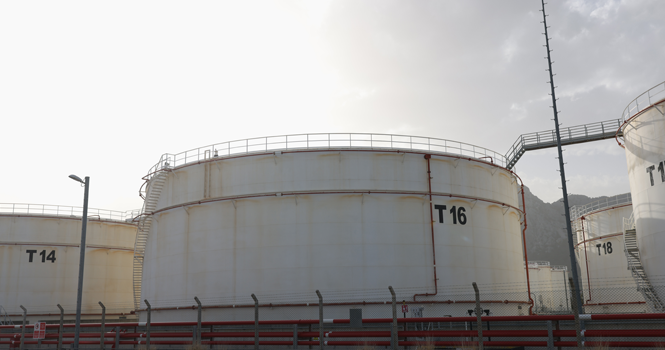
A Ukrainian drone attack sparked a fire and damaged several storage tanks at a fuel depot in Russia’s Krasnodar region, the region’s crisis administration said on Thursday.
About six drones were destroyed and debris fell on the refinery near the village of Yurovka, the administration said on the Telegram messaging app.
“Several tanks were damaged,” the administration said, adding no one was injured in the attack.
Drone attacks on energy facilities inside Russia’s territory have become more frequent in the past few months. Kyiv officials say that they conduct the attacks to undermine Russia’s war effort and respond to Moscow’s strikes on Ukrainian energy infrastructure.
The oil depot was last attacked on May 2, according to Russian state media. REUTERS
Crude oil inventories in the US fell lower than analyst estimates last week, while gasoline and distillate stocks rose.
Crude oil inventories in the US declined by 1.4 million barrels in the week ended May 3, compared to estimates for 1 million barrels, data from the US Energy Information Administration (EIA) showed.
Meanwhile, gasoline stocks were up by 900,000 barrels. Distillate stocks also increased by about 600,000 barrels.
Israeli warplanes struck Gaza’s crowded southern city of Rafah Thursday after US President Joe Biden vowed to stop supplying artillery shells and other weapons to Israel if a full-scale assault goes ahead.
It was the starkest warning yet from the United States, Israel’s main military provider, over the civilian impact of its war against Hamas.
An AFP correspondent and witnesses on Thursday reported Israeli strikes on several parts of Rafah, where the United Nations said 1.4 million people were sheltering.
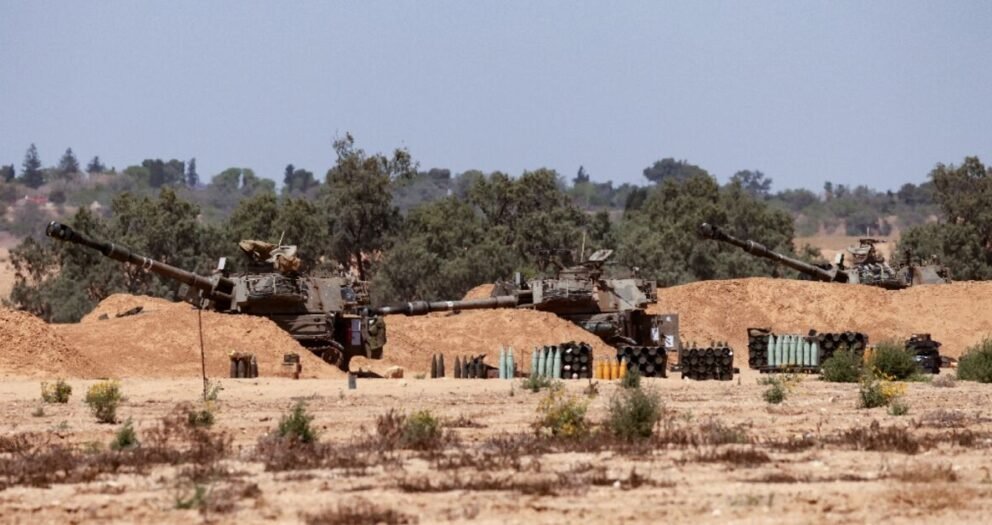
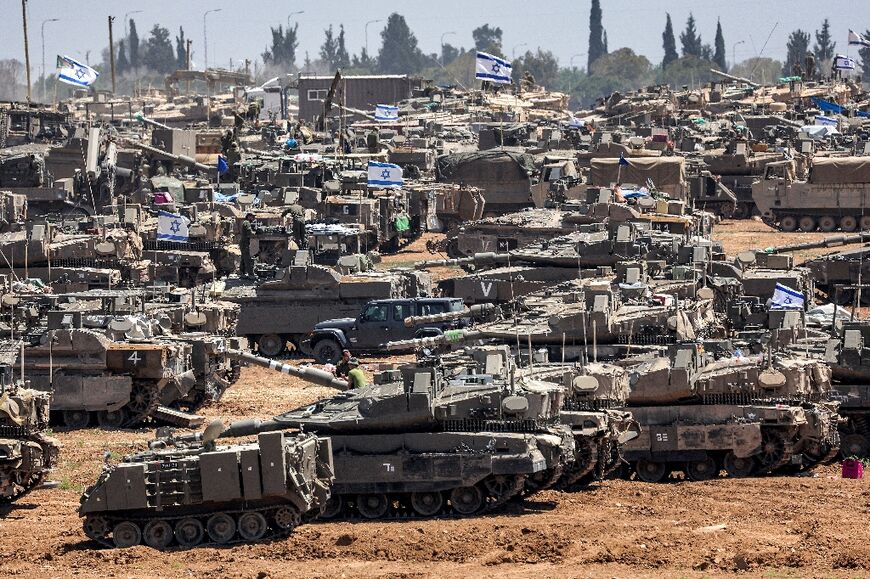
“The tanks and jets are striking,” Tarek Bahlul said on a deserted Rafah street. “Every minute you hear a rocket and you don’t know where it will land.”
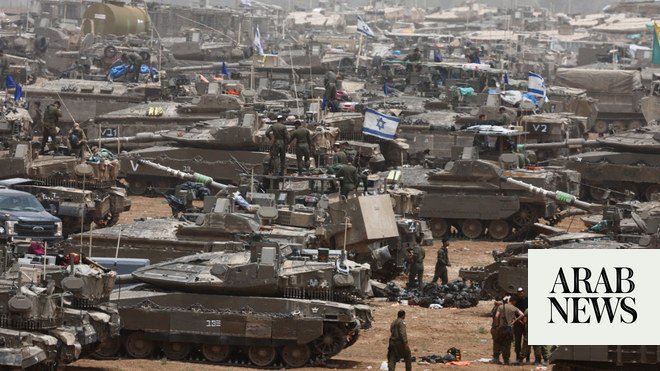
Israel has already defied international objections by sending in tanks and conducting what it called “targeted raids” in the east of Rafah, the city it says is home to Hamas’s last remaining battalions.
The Hamas authorities’ “emergency committee” in Rafah dismissed as “nothing but lies” Israel’s description of its operation as “limited”.
In an interview with CNN on Wednesday, Biden warned he would stop some US weapons supplies to Israel if it carried out its long-threatened ground assault.
Israel on Thursday called Biden’s comments “very disappointing”.
Biden told CNN: “If they go into Rafah, I’m not supplying the weapons that have been used… to deal with the cities.”
“We’re not gonna supply the weapons and the artillery shells that have been used.”
– Bomb delivery halted –
The fresh warning came after his administration paused delivery last week of 1,800 2,000-pound (907-kilo) bombs and 1,700 500-pound bombs as Israel appeared ready to attack Rafah.
“Civilians have been killed in Gaza as a consequence of those bombs,” Biden said. “It’s just wrong.”
Ties between the allies have become increasingly strained as Biden and other top Washington officials criticise Israel over its conduct of the war.
Pro-Palestinian protests have flared at universities across the United States with an intensity not seen for decades.
The Gaza war began with Hamas’s unprecedented October 7 attack on Israel, which resulted in the deaths of more than 1,170 people, mostly civilians, according to an AFP tally of Israeli official figures.
During their October attack militants seized some 250 hostages, of whom Israel estimates 128 remain in Gaza, including 36 who officials say are dead.
Israel’s retaliatory offensive has killed at least 34,904 people in Gaza, mostly women and children, according to the Hamas-run territory’s health ministry.
– Aid operations ‘crippled’ –
The United Nations agency for Palestinian refugees, UNRWA, said 80,000 people have fled Rafah since Monday, but “nowhere is safe”.
On Tuesday, Israel seized Rafah’s border crossing into Egypt, which had been the main entry point for aid.
The White House condemned the aid disruption, and the defence secretary later confirmed Washington had paused the bomb shipment.
In Israel’s first reaction to Biden’s threat, its UN ambassador Gilad Erdan called it a “very disappointing statement”.
Prime Minister Benjamin Netanyahu made no direct mention of the US threat but said in a statement: “If we have to stand alone, we will stand alone.”
It has been his repeated refrain in recent days as both international and domestic criticism of his handling of the war have intensified.
Israel’s military said Wednesday it was reopening another aid crossing into Gaza, Kerem Shalom, as well as the Erez crossing into north Gaza.
But the head of the UN humanitarian office in the Palestinian territories, Andrea De Domenico, told AFP that military activity at Kerem Shalom made civilian aid deliveries practically impossible.
He said the closure of the Rafah crossing, the only one equipped for fuel deliveries, had effectively halted aid operations.
“In Gaza there are no stocks” of fuel, he said. That “means no movement. It is completely crippling the humanitarian operations.”
UNRWA chief Philippe Lazzarini announced late Thursday that the agency was closing its east Jerusalem headquarters after the latest in a spate of attacks by “Israeli extremists” put its staff at “serious risk”.
Lazzarini said the compound would remain closed “until proper security is restored”.
– US aid ship leaves for Gaza –
A US container ship loaded with aid for Gaza left Cyprus Thursday in a new test of a maritime corridor to get relief into the besieged Palestinian territory, the Cyprus government said.
US military engineers have been assembling a temporary pier to unload aid deliveries but the work has been delayed by heavy seas.
“The platform is expected to be ready by the time the ship arrives in order for the aid to be unloaded and distributed to Palestinians in need,” Cyprus government spokesperson Yiannis Antoniou said.
US Secretary of State Antony Blinken has said the pier will “significantly increase” the volume of aid reaching Gaza but said it was not a “substitute” for greater land access via Israel.
Hamas called for an end to aid airdrops Thursday after two Palestinians were killed when an aid pallet crashed into a warehouse after its parachute failed to open.
At least 21 people have now been killed in Gaza airdrops by Arab and Western air forces that have gone wrong, according to the Hamas authorities.
Israeli and Hamas negotiating teams left Cairo Thursday after what the Egyptian hosts described as a “two-day round” of indirect negotiations on the terms of a Gaza truce, Egypt’s state-linked Al-Qahera News reported.
White House National Security Council spokesman John Kirby said the head of the US delegation, CIA director Bill Burns was also headed home.
“That doesn’t mean there aren’t still ongoing discussions,” Kirby said.
“We still believe that there’s a path forward, but it’s going to take some leadership on both sides.”
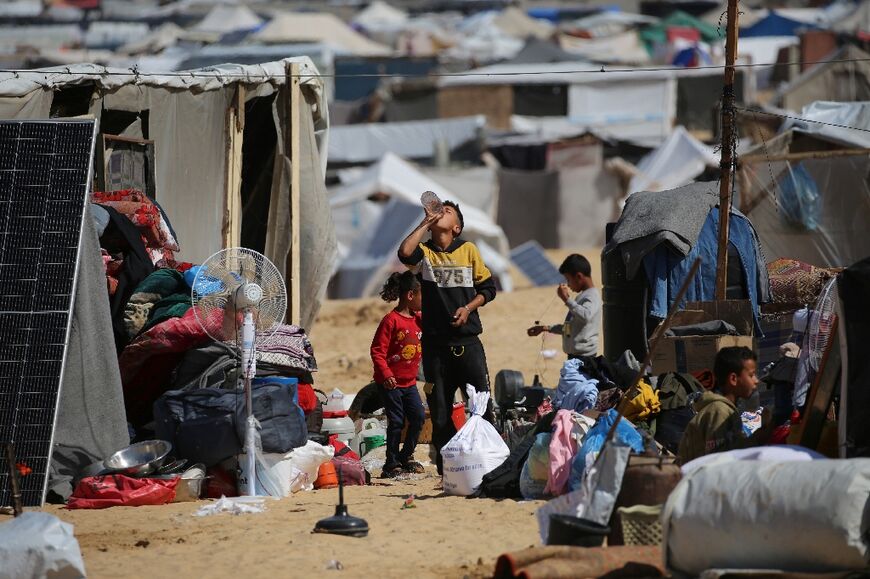
At a makeshift refugee camp in Rafah, Mazen al-Shami said she was fed up.
“We have no money and we don’t have the means to move from one place to another again and again. We have no means at all,” Shami said.
Displaced Gazan Marwan al-Masri, sheltering in Rafah, said on Wednesday “life has completely ceased” since Israeli tanks and troops entered the city’s east, sending desperate Palestinians fleeing north in the besieged territory.
More than 1.4 million people had crammed into Rafah, a city on the Gaza Strip’s southern border with Egypt, as Israeli forces pushed their way southward from the coastal territory’s north during months of war against Hamas militants.
Many in Rafah have been displaced multiple times during the seven-month war, and are now heading back north after Israeli forces called for the evacuation of the city’s eastern past, which hosts tens of thousands of people.
“Life has completely ceased in the downtown area of Rafah”, said 35-year-old Masri, who has been displaced from northern Gaza.
“The streets are empty of people, and markets are in a state of paralysis”, he told AFP.
“We all feel fear of any advancement in the invasion, as happened in the eastern areas, which are now completely empty of residents”.
Masri said he and his relatives “are all tense and frightened” by the incessant shelling that they feel is getting closer to them.
Ibtihal al-Arouqi, who was displaced from Al-Bureij refugee camp in central Gaza, said she has found herself once again homeless.
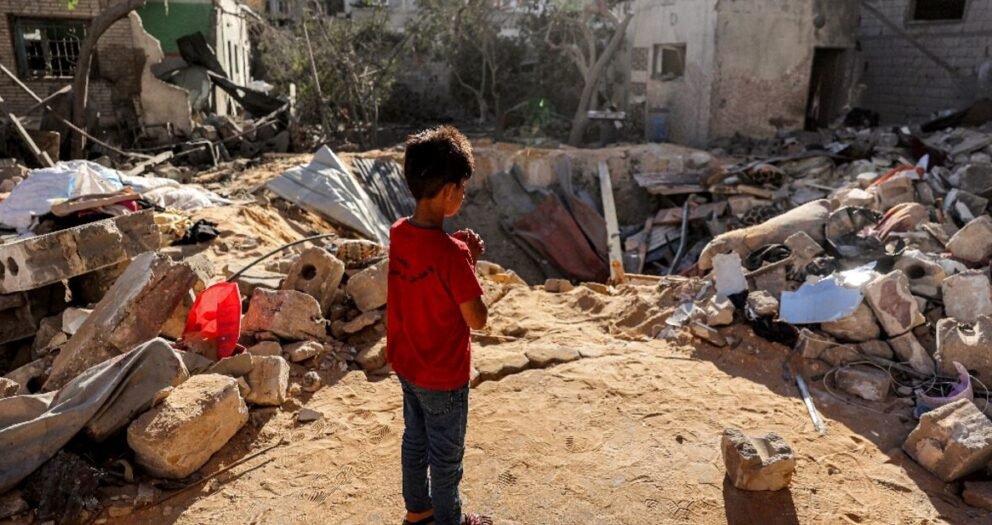
“We emerged from under the rubble of our house in Al-Bureij, and now due to intense shelling in Rafah, my children and I are in the street”, she said.
The 39-year-old said that only two weeks ago she gave birth by Caesarean section.
“We don’t know where to go. There is no safe place”, Arouqi added.
She spoke from west Rafah, where many Palestinians remain.
While it is relatively calmer than the city’s heavily bombarded east, the west has also been hit by shelling, an AFP journalist reported.
Both Arouqi and Masri said incessant shelling has filled the air with dust and smoke that make it hard to breathe.
“The situation in Rafah is chaotic,” said Mohammed Abu Mughaiseeb, a medical coordinator for Doctors Without Borders (MSF) charity in Rafah.
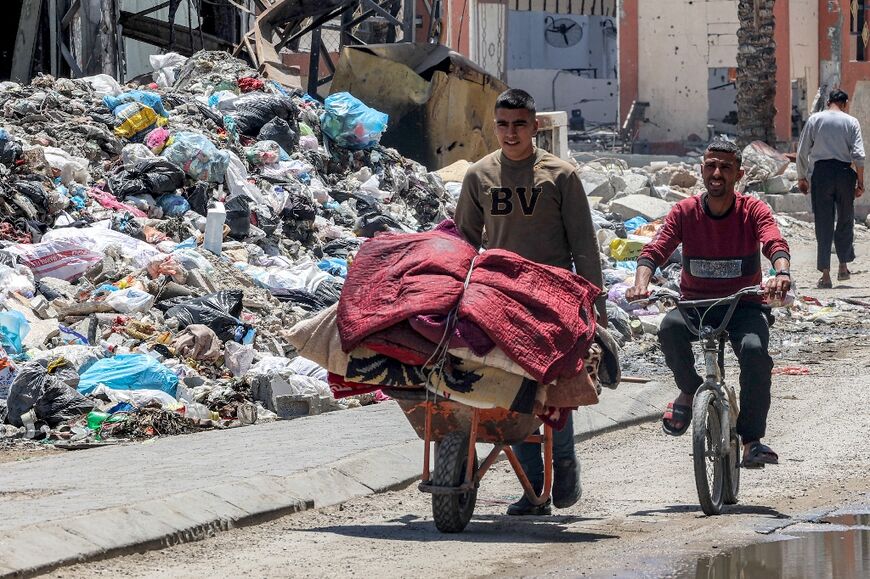
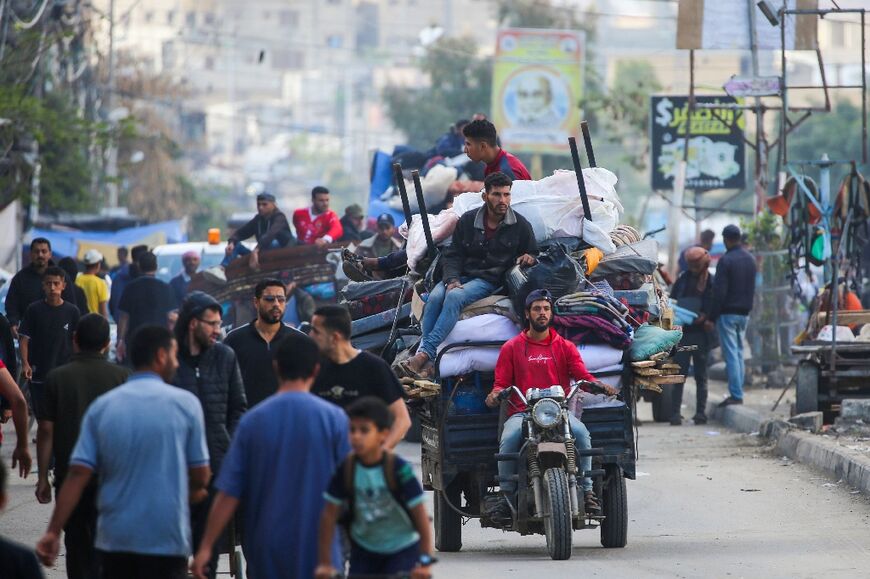
Himself displaced from Gaza City, he described “people carrying their things, mattresses, blankets, kitchen items on trucks” to flee east Rafah.
But “there’s no space anymore in the west of Rafah,” Abu Mughaiseeb told AFP.
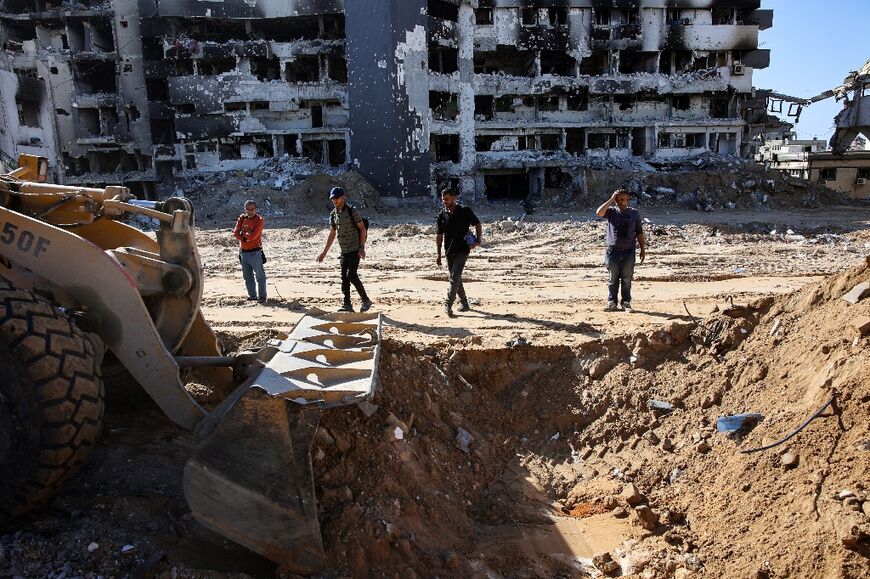
The city’s Al-Najjar hospital was “closed, evacuated by the medical team to avoid what happened in Al-Shifa or Nasser”, he added, referring to two other Gaza medical facilities raided by Israeli forces during the course of the war.
– ‘No room’ –
Caught between Israeli shelling from the east, an Egyptian border to the south and the Mediterranean to the west, many fleeing Rafah went north.
They headed towards the nearby city of Khan Yunis as well as Deir al-Balah in central Gaza, where thousands of tents filled up the coast.
Ahmed Fadel, 22, is one of many retracing his steps, returning to the northern parts of Gaza he had fled earlier on in the war.
Originally from Gaza City, he was first displaced to Nuseirat refugee camp in central Gaza, and then ordered to leave when Israeli troops entered the nearby Al-Bureij camp.
“We left and moved to Rafah but they pummelled and threatened the city, so we came to Deir al-Balah — which is already crammed,” he told AFP.
AFP journalists witnessed long lines of displaced Palestinians fleeing Rafah on cars, trucks, donkey-pulled carts, tuk-tuks or by foot, carrying what belongings they could.
AFP footage on Wednesday showed thousands of tents and shelters packed along Deir al-Balah’s coastal area.
On the ground streets were packed with people unloading belongings or selling wares.
“Deir al-Balah is a small city”, local merchant Abdelmajid al-Kurd told AFP.
“It’s a very small town that is now extremely overcrowded”, he said.
“There’s no room or facilities to accommodate these people.”
Lorem Ipsum has been the industry's standard dummy text ever since the 1500s, when an unknown printer took a galley of type and scrambled it to make a type specimen book.
Lorem Ipsum has been the industry's standard dummy text ever since the 1500s, when an unknown printer took a galley of type and scrambled it to make a type specimen book.
Lorem Ipsum has been the industry's standard dummy text ever since the 1500s, when an unknown printer took a galley of type and scrambled it to make a type specimen book.
Lorem Ipsum has been the industry's standard dummy text ever since the 1500s, when an unknown printer took a galley of type and scrambled it to make a type specimen book.
Lorem Ipsum has been the industry's standard dummy text ever since the 1500s, when an unknown printer took a galley of type and scrambled it to make a type specimen book.